About Me

My photo
Hammersmith, London, United Kingdom
I'm a director of Maidenhead United Football Club. For ten seasons one of my roles at the club was to produce the match programme. The aim of this blog was to write football related articles for publication in the match programme. In particular I like to write about the representation of football in popular culture, specifically music, film/TV and literature. I also write about matches I attend which generally feature Maidenhead United.

Wednesday, 22 February 2023

 Magpie Miscellany Part 15

When Honeyball’s Female Pioneers drew thousands to York Road

Maidenhead United’s women's team was set up in 2008 and has gone on to track the inexorably upward trend of the game as a whole. As I write they look set fair to retain their status in the fourth tier of the domestic structure for the eighth successive season.
The belated development of the team reflects the disgraceful historic treatment of the women’s game by the FA. In 1921 the FA effectively banned women’s football by forbidding any member club to host matches, a ruling that was not overturned until 1969.

The 1921 ban came at a time of burgeoning popularity for the women’s in the aftermath of World War One which had seen the development of ‘Mutionettes’ teams made up of female workers from armaments factories. One such team had played at Kidwells Park, home of the Norfolkians, in 1918. However you have to go back to 1895 for the first recorded women’s match at York Road, when what is reputed to be the first female Association Football club, played one of their earliest fixtures there. 

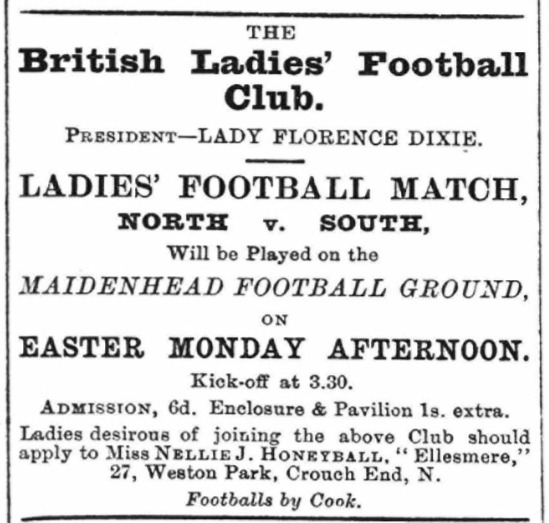
The British Ladies Football Club was formed in late 1894 by Nettie Honeyball in North London. In the New Year Bray resident Lady Florence Dixie was appointed President with the Maidenhead Advertiser reporting that: “At present the practice of the club is conducted in private, but the ladies, who are most enthusiastic, intend very shortly to invite the public to attend.” This led to club secretary Honeyball arranging a match at York Road on Easter Monday.

Dixie (pictured right) was an appropriate choice of figure head. A Scottish writer and feminist, her grandfather William Clayton had been MP for Great Marlow. Her eldest brother John, the Marquess of Queensbury, created the rules that became the foundation for modern boxing, but achieved notoriety for instigating the prosecution of Oscar Wilde following the revelation of Wilde’s relationship with his son Alfred Douglas. She shared her brother’s love of sport but not his political views, and became an ardent progressive campaigner, using her role as a novelist to portray strong women and themes of gender equality. In 1883 her support for Irish self determination led to an assassination attempt near her home in the Fisheries. On accepting her appointment as BLFC President she said: “the girls should enter into the spirit of the game with heart and soul.".

BLFC soon attracted enough members to run regular training sessions at Alexandra Park under the guidance of Tottenham Hotspur wing half Bill Julian and played their first match at Crouch End on March 23rd 1895 in front of a 10,000 crowd, with the players being divided into north and south teams. Further matches followed in Brighton and Bury before the club arrived in Berkshire at Easter.

This proved to be an historic weekend for football in Maidenhead in more ways than one, with the men winning their first ever Berks & Bucks Senior Cup on Easter Saturday by beating Marlow at Kidwells Park, whilst on Monday morning they welcomed the Paris Association for a friendly. 

Honeyball hired the York Round ground in the afternoon for £5 with the opportunity to keep all the gate money. She also scheduled a match at Reading in the morning. When the players arrived by train from the first match in Biscuitopolis, they headed straight to the MFC headquarters at The Bell pub (now O’Neill’s)

Unfortunately some of the players were delayed so the teams were 8 a side with a man in goal at each end. The North wore red,  the South blue.

Playing 30 minutes each way, the Blues led 3-1 at half time having the slope in their favour. The Reds (pictured left before their first match at Crouch End) levelled the score, only for the Blues to take the lead again before a final equaliser saw the game finish 4-4. 

The crowd was estimated as being between 3-4 thousand and paid over £54 in gate money (equivalent to over £9,000 at 2023 prices). In contrast the crowd for Maidenhead’s Cup Final win at Kidwells Park two days earlier was only 1,772, whilst the morning match between Maidenhead and Paris failed to attract four figures.

After the match Honeyball (pictured right) spoke to the Maidenhead Advertiser in The Bell: “I formed this club entirely on my own responsibility, because I have been accustomed to athletics all my life with my brothers. Being an expert myself in tennis and cycling, a thought came into my head. Why can’t women play the popular game of football as well as tennis, boating and cricket? I am both captain and promoter. Wherever the girls go I accompany them. I advertised for ladies to form a team in October. Replies? I had dozens but some of the applicants didn’t relish the idea at first to come out in public. They have got over that now though. We have at present 24 playing members with six more on the list ready to play whenever called upon. They are all educated young ladies and belong to what I term the upper middle class. They are mostly all from different parts of London, but we have one from the north. If I accepted all the girls from the masses that made applications to join us, why our list would have been filled long ago. It is my object to let the world know that women are not so silly as men think them to be. I have myself received many letters denouncing our conduct. Such criticism we put down to the ignorance of the writers. I am also glad to say that the tone and the criticism is getting milder.” 

Sadly Honeyball was disappointed by the York Road crowd: “The applause was encouraging enough, but the remarks passed by some of the crowd were not all that could be desired. On leaving, several of the girls were insulted by youths and boys. At Bury, in Lancashire, where we played last week before a crowd of working men, we had a magnificent reception and we were treated throughout as we ought to be.”

Indeed the Advertiser reporter described the match as a “farce” whilst columnist ‘Trifler’ said it was “a feeble exhibition, more fun than football, the large and curious crowd were disappointed at the ladies’ display”. ‘Looker-On’ thought the “impression they created was expressed by shrugs rather than words”.

The following autumn, the team looked to return to the area with a match at Burnham but the local club declined the offer due to fears that the gate would not be big enough. 


Sources:

BBC

HISTORY OF THE WOMEN'S FOOTBALL ASSOCIATION

Maidenhead Advertiser

National Football Museum

Spartacus Education: Nettie Honeyball

Wikipedia: British Ladies FC, Lady Florence Dixie, Nettie Honeyball


Sunday, 12 February 2023

 Magpie Miscellany Part 14

When Harry met Boublis

Prestigious pre season friendlies are manna from heaven for non league football clubs, perhaps second only to an FA Cup run in terms of the profile and revenue they can provide.

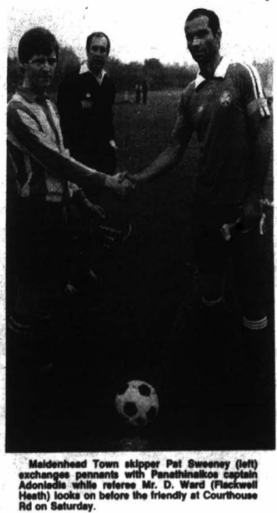
This was illustrated a few seasons ago by the visit of the Kuwaiti national team to the Thames Valley but pales in comparison to Greek champions Panathinaikos trip to a Maidenhead park forty three years ago.

Maidenhead Town was a Hellenic League club based in Oaken Grove off Courthouse Road, with no connection to the team that currently bear the name. Their home was the archetypal pitch with a barrier surrounding it adjacent to an infant school in the park to the north of Maidenhead which is familiar to anyone who has played youth or Sunday football locally. Town had begun as Maidenhead Social in the early 70s going onto win the Division One title in 1975. They reached the Premier Division in the 80s and enjoyed a fair degree of popularity in the town contesting a memorable County Cup tie at York Road in 1985. Ultimately their location was their downfall, as ground grading confined them to the Chiltonian League, with the final death knell sounding when a small housing estate was built on their pitch. They folded in 1990.

The Stags started the decade on a high though, securing promotion to the Hellenic League Premier Division in 1980 as runners up in Division One, with the friendly against a real Hellenic team Panathinaikos on 1st August 1980 heralding the start of their newly elevated status.

Known as The Greens or Shamrocks, Panathinaikos remain the oldest active football club in Greece, which turned fully professional in 1979. They had finished 3rd in the previous season’s Alpha Ethniki to qualify for the UEFA Cup, with four players representing Greece at the 1980 European Championship. In June they appointed a new manager, former England striker Ronnie Allen, who brought his team to Bisham Abbey for pre season training, staying at the Walton Cottage Hotel on Marlow Road.

The match was taken seriously by Allen, who fielded five internationals, including new Argentinian signing Juan Rocha (then known as Boublis), whilst Town included future Maidenhead United legends David ‘Harry’ Harrison and Andy Smith.

Maidenhead Advertiser reporter Clive Baskerville described the Greeks as being “several classes better in terms of skill and ball sense” but “traditional English fire and application” saw Allen and his coaching team spend “most of the second half anxiously pacing up and down the touchline in the second half, shouting at their players and shaking their heads in disbelief”.

This followed a first half which went to form, Panathinaikos going into the break 2-0 up thanks to goals from Antonis Antoniadis (one of two survivors in the Greens team from their 1971 European Cup final runners up line up) with a twenty yard volley in the 36th minute, and a delicately struck shot from twenty five yards by Spiros Livathinos, two minutes before the interval.

In customary fashion for a friendly, both teams made changes to their team for the second half, which handed the advantage to Town who levelled the score within 13 minutes of the restart. Firstly Dave Hale converted a Ray Barber cross, then Pat Sweeney won a penalty which Hale scored at the third attempt after the referee judged that goalkeeper Alexiou had moved early in saving the first two efforts.

Town dominated the rest of the match but couldn’t get their noses in front and in stoppage time the Greeks saved their blushes when Ore broke the offside trap and rounded the keeper to score the winner. Nevertheless the three hundred crowd went home proud at seeing a fighting performance from the local heroes.

The season that followed saw Town consolidate their position in the Hellenic League Premier Division in a final place of 10th whilst Panathinaikos finished 5th in the Alpha Ethniki to qualify for the UEFA Cup once more although manager Allen only lasted six months in post.


Sources:

Football Club History Database

Maidenhead Advertiser

Wikipedia


 Magpie Miscellany Part 13

When Busby & a Lisbon Lion played at York Road

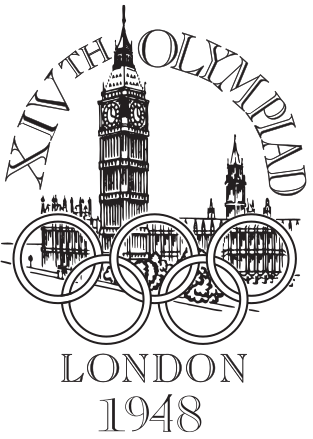
“Maidenhead can be very proud of its ground and accommodation. It is a credit to the club and its supporters. Many a football league club would be pleased to have such fine facilities”. This was the verdict of Matt Busby at the conclusion of his 1948 GB Olympic team training camp at York Road.

75 years ago, Britain was preparing to host the Olympic Games for the second time. What became known as the Austerity Games was the first Olympics since the notorious event in Berlin in 1936.

The games had originally been awarded to London in 1944, and despite concerns that there were insufficient resources to host the event following the end of World War II, it went ahead albeit with no new facilities being built. The Wembley Stadium complex was the focus of the games, although events took place throughout London and across the south of England.

This was particularly true of the football tournament which was played at 9 London venues including Lynn Road (Ilford FC) and Green Pond Road (Walthamstow Avenue FC), as well as the Goldstone Ground (Brighton) and Fratton Park (Portsmouth).

Football has always been one of the biggest Olympic sports, regarded seriously in most of the world outside Great Britain. This was exemplified by Uruguay at the recent World Cup in Qatar when they wore two gold stars on their shirt to represent their Olympic Gold medals from 1924 and 1928. Of course Team GB always had the problem of consolidating the four home nation teams into one eleven, not to mention an arcane attitude to amateurism which occasionally crossed the line into hypocrisy.

Nevertheless as host, just as in 2012, it was deemed necessary to field a team capable of winning the competition, especially as it was to be the first ever football tournament to be broadcast live on BBC TV. 

Thus Matt Busby, fresh from winning the FA Cup and leading Manchester United to a second consecutive Football League runners up spot, was appointed manager/coach.  

Following a trial match at Blackpool in May, an FA committee selected a 22 man squad of registered amateurs. After mixed fortunes in two friendly matches, beating The Netherlands and losing to Basel, the squad arrived at the Grove Hall Hotel, Twyford in mid July for their pre tournament training camp. The squad consisted of 10 Englishmen, 7 Scots, 3 Welshmen and 2 from Northern Ireland. All the Scots played for Queens Park and included the future Lisbon Lion goalkeeper Ronnie Simpson. The captain was Bishop Auckland’s Bob Hardisty. There was local interest in the form of right back Jack Neale who played against the Magpies for Walton & Hersham in the Corinthian League, and Reading based forward Bill Amor. 

Amor, a wartime Royal Marine, had joined Thames Valley Police in peacetime and was spotted playing for Spartan League Huntley & Palmers by Third Division Reading earlier in 1948 for whom he went on to play 68 matches on the left wing. He came to the attention of the Team GB selectors after scoring a hat trick for an FA XI against Queens Park who were then playing in Scotland’s top ‘A’ Division.

Busby’s squad started 10 days of intensive training at York Road on July 15th. They arrived by coach from Twyford twice a day for a morning and afternoon training session. Busby joined in the sessions which included running, exercises, ball control, 5 a side and tactics. One afternoon they played a cricket match for a change.

On July 20th the squad played a Reds v Whites trial match in hot weather. Busby lined up in midfield for the Reds. Maidonian Harry Distin refereed.

The Magpies did everything they could to help the squad prepare. This included daily hot baths, cold showers and afternoon tea. The Conservative Club also offered hospitality. Full cooperation was given by the Borough Surveyor’s department to get the ground in to condition.

On July 24th the squad travelled to Nantes to play France in a friendly which they won 3-2. Described by Busby as a “rough” game with six French subs required, Queens Park’s David Letham injured his knee and subsequently missed the tournament.

The squad had a final training session at York Road on July 27th, then transferred to their tournament quarters at the Olympic Centre in Uxbridge.

Busby described himself on leaving Maidenhead as “optimistic” about his team’s chances. This proved well founded as three days later GB won their first round tie by the odd goal in seven after extra time against The Netherlands at Highbury. This set up a quarter final against France at Craven Cottage when Hardisty scored the only goal midway through the first half.

The tournament then moved to Wembley for the final stages. A general lack of interest in the competition was reflected by a crowd of only 40,000 for GB’s semi-final against Yugoslavia. Despite this being the biggest attendance GB had played in front of that summer, it was still only marginally better than the previous season’s Football League First Division average of 36,137.

The Yugoslavs took the lead through Stejpan Bobek in the 19th minute but within seconds Pembroke’s Frank Donovan equalised for GB only for Franjo Wolfl to restore the Eastern European’s lead four minutes later. The tie was settled just after half time when Rajko Mitic doubled his team’s advantage. This left GB with a final match against Denmark which they lost 5-3 to miss out on a Bronze medal.

In the tournament final Yugoslavia were comfortably beaten 3-1 by Sweden whose famous Gre-No-Li forward line of Gunnar Gren, Gunnar Nordahl and Nils Liedholm would go on to have great success with AC Milan in the 1950s.

Of the Brits, Busby would go onto greatest fame, eventually being knighted for his achievements at Manchester United which concluded with 1968’s European Cup triumph. However Ronnie Simpson beat Busby to the ultimate European club title a year earlier when he kept goal in Celtic’s 1967 final win in Lisbon. This ended a glittering career which included 2 FA Cups with Newcastle, 8 domestic trophies for Celtic as well as playing for Scotland at Wembley when they inflicted the legendary first defeat of Alf Ramsey’s English World Cup winners. Bob Hardisty went to become a triple Amateur Cup winner with Bishops Auckland and rejoined Busby in 1958 to help United out as a player following the Munich air disaster. 


Sources:

100 Reading Greats, David Downs

BBC Genome Project

England Football Online

Guardian Archive

Maidenhead Advertiser

One for Sorrow, Two for Joy, Mark Smith, 2011

Wikipedia

World Football


Tuesday, 3 January 2023

 Magpie Miscellany Part 12

Yesterday’s Hero

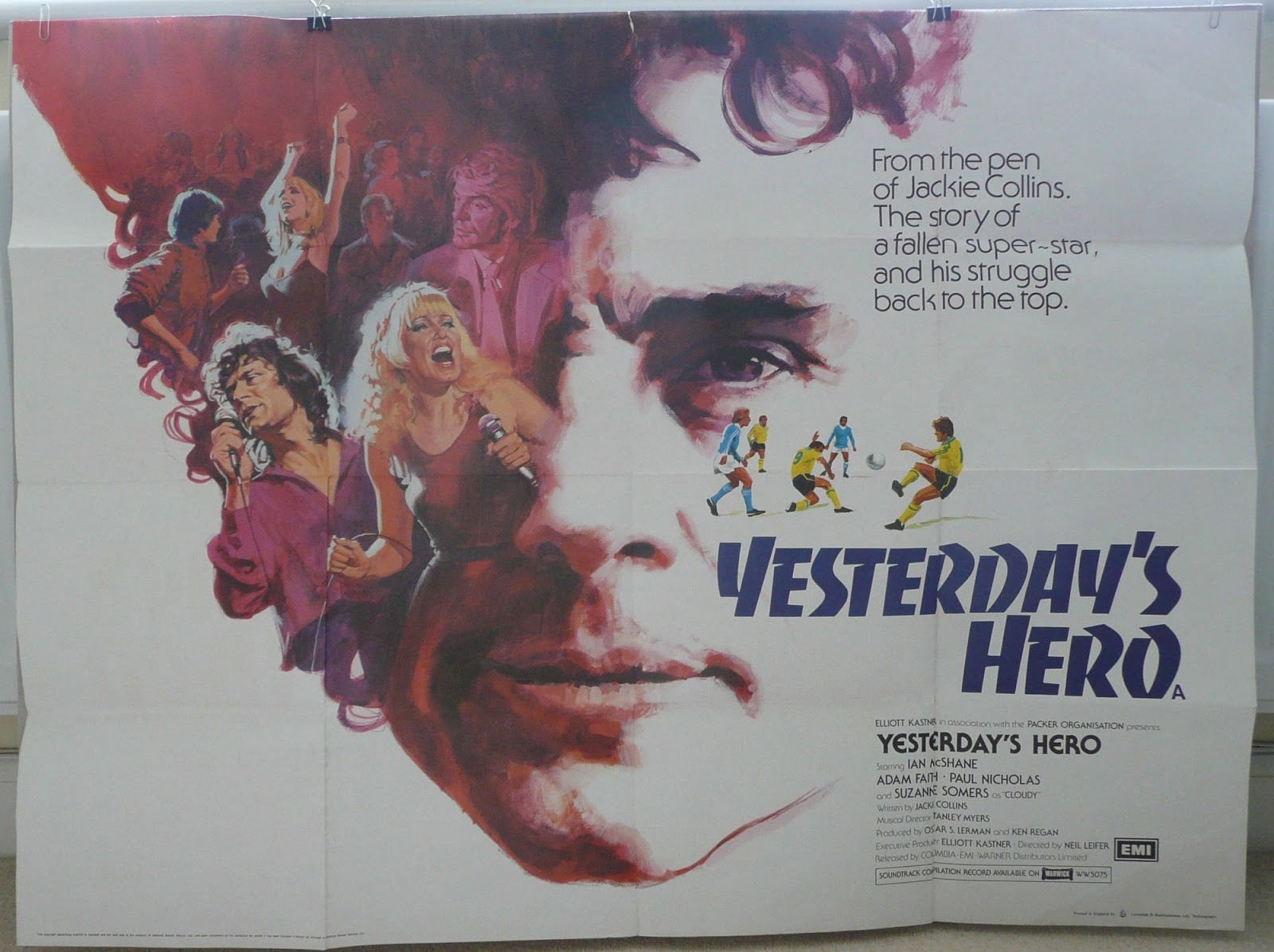
York Road is no stranger to the silver screen. In 1951 it was used as the setting for a pivotal scene in the Ealing Studios production, The Card, starring Alec Guinness. 

In 1979 the cameras returned, this time for the Ian McShane film, Yesterday's Hero. It's a story packed with cliches as hackneyed as any other football drama. Scripted by Jackie Collins, the story is centred on Rod Turner (McShane), an alcoholic washed up football star playing for Windsor, and features a host of familiar faces from contemporary sitcoms and soaps.

McShane had a claim to having the footballing talent required for the role, with his Scottish father Harry having had a long career as a Football League player with spells at Bolton Wanderers and Manchester United. The use of locations and the way real match footage is used is also creditworthy reflecting Frank McLintock's role as football adviser.

York Road's role is over and done with in the first three minutes of the film which opens with a shot which pans down Bell Street with a train in  the background. The famous Bell St End then comes into view with a handful of spectators watching a game, presumably between Maidenhead (in red) and Windsor (blue and white stripes). I understand that American director Neil Leifer requested that the pitch be flooded to give it an authentic glue pot appearance in return for a sizable facility fee. This ruined the playing surface for the remainder of the season and arguably cost the Magpies promotion as they fell five points short in third place.


The action is played out over the intro song, with contemporary Maidenhead United, Windsor and Wokingham Town players featuring as extras. There are some magnificent shots of the ground, with the cameras on the York Road side. You can see what was the covered terrace on the railway side, plenty of grass beyond the perimeter and some tantalising shots of the stand that sadly burned down in 1986. The wall at the Bell Street end is a pre mural plain, with the scene feeling very recognisable as the club shop, tea bar and shelf come into view.

After the game Turner heads out for a drink with his father and friends at the Ivy Leaf club and the action switches to a concert by singer Clint Simon (Paul Nicholas) and partner known enigmatically as Cloudy (Suzanne Somers), a beta version of Dollar channelling the Dooleys and the Brotherhood of Man.

In the style of Pete Winkleman, Simon is the music impresario owner of third division club The Saints (no location but the players wear Southampton's away kit), who have just won their FA Cup quarter final against Birmingham Rovers at the cost of an injury to striker John Snatcher. Despite the misgivings of manager Jake Marsh (Adam Faith), Simon decides Turner is the answer to the Saints problems and sets out to recruit him at the next Windsor home game.

In the meantime, in between regular sips from a ubiquitous whisky bottle, Turner also coaches boys from a children's home whilst fending off any thoughts of commitment to girlfriend Glynis Barber and hoping for a move to the US from dilettante agent Alan Lake.

Turner meets Simon after a game at Stag Meadow, which looks pretty much unchanged 43 years later, and ends up going straight into the Saints semi-final line up to face Hamilton United (wearing the Ipswich home kit), at Portman Road.

All is going to plan, as inspired by Turner's presence, the Saints go into half time 2-0 up with Turner scoring the second. However a half time dram signals trouble with the manager and although the scoreline remains the same, once John Motson has left the post match dressing room celebrations, Marsh issues Simon with a "him or me" ultimatum.

Just in case his fate was in doubt, Turner goes on to punch Marsh at a nightclub later that evening before spending the night with Cloudy, which ensures Barber moves to the Marsh corner.

Returning to the back pages for all the wrong reasons, Turner is shunned by one of the boys at the children's home and at last resolves to win his place back, pacing the mean streets of Windsor to get fit. This provides him with a place on the bench at Wembley as The Saints attempt to become the first third division team to win the Cup. Opponents Leicester Forest (in the tricky trees' red) stand in their way and using footage of the actual 1979 League cup final, Forest race into a two goal lead before Saints pull one back just before halftime.

Following an unbelievably uninspiring half time talk from Marsh, the Saints do little to threaten a comeback until with eight minutes remaining Tony Keys has to make way for Turner due to injury,

Can you guess what happens next?


 Sources:

Maidenhead Advertiser

One for Sorrow, Two for Joy, Mark Smith, 2011


Wednesday, 28 December 2022

 Magpie Miscellany Part 11

The Southall Catastrophe

Transport to an away match does not always go to plan. Any mention of a trip to Torquay will lead to a reminder of the evening match a few years ago when heavy traffic prevented the coach arriving before 8 pm with a 4-1 defeat ensuing. About 20 years ago those sitting on the coach returning from Heybridge were disturbed to see one of the wheels rolling past, which led to a long wait on the hard shoulder for a replacement vehicle with thankfully no one hurt.

Way back in 1898, a Southern League match at Southall, led to a similar tale for the ages. The outward journey was without incident but the “intense heat” led Captain (and Secretary) Stiv Gibbons to decide he would not play and a replacement was found from the Reserves. Maidenhead won the toss and kicked off with the sun at their backs at 4:30 pm before “a large attendance”.

Southall had won both of their opening league matches and, after a combative start, took the lead through Hobson. Maidenhead equalised with a penalty from Edwards after Collyer had been tripped by Reed. The score remained level at half time. 

Just after the hour mark, Hobson scored twice to complete his hat trick. Alf Walton pulled one back but despite a “more skilful exhibition than their heavy opponents”, Maidenhead were to return home empty handed. 

The late finish and the imminent departure of the next train meant everyone was keen to get back to the station as soon as possible as “Southall is not a desirable place to spend an hour… scarcely inviting and possessing no charm for outsiders”.

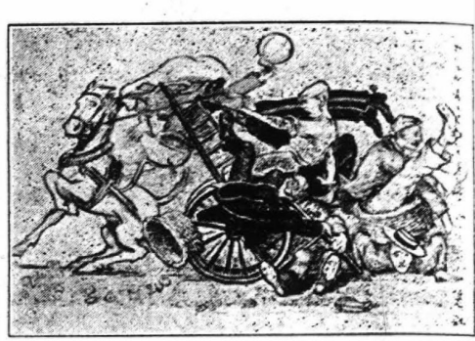
With the sun still “blazing” there was no desire to walk the mile back to the station. There was a cab at the football ground but this had already been hired. The remaining four Maidenhead players, and referee Mr Scroggs were spotted by a “genial coster” (someone who sold goods from a cart on the street) who saw a chance to “earn a few honest sixpences”. So he offered to drive the five to the station for a tanner (sixpence)  a head. They eagerly jumped on the cart. “The pony was a goer and away the quintette sailed down the street in the seventh heaven of delight”.

They soon passed club mate Walton who accepted the invitation to jump aboard. Unfortunately this proved to be “the final straw. Without warning snap went both of the shafts and up flew the cart”.

The driver was left “clinging to reins and pulling his nag almost on its haunches, while one end of the barrow was in mid air” with the four passengers flying out of it, “landing in and amongst fruit baskets, while apples, pears, nuts and oranges flew about the roadway”.

“Lowman slid gracefully down the chute head first into a basket, legs well up. Walton, having the shortest distance to fall, was soon on his legs and he at once ran to the nag’s head to prevent it from bolting. Meanwhile, Referee Scroggs and the others sorted themselves out from among the fruit and baskets and bags. They had assumed most grotesque postures, men, bags, baskets and fruit being almost inextricably mixed up. Meanwhile, to complete the picture some lively boys improved the occasion by pocketing nuts and apples, making off when the coster regained his equilibrium”.

Fortunately no one was hurt seriously, so whilst the coster tidied up, “his erstwhile passengers hurried to the station on foot, scarcely able to restrain their hilarity”.  They did have a whip round for the coster to help him pay for any damage or loss. 

What quickly became known as the catastrophe was the “principal topic of conversation among Maidenhead footballers” for the next week with local artist Archibald Smith capturing the incident for posterity, which was made available to buy as a print from Queen Street photographer Bert Richardson.


 Sources:

One for Sorrow, Two for Joy, Mark Smith, 2011

Maidenhead Advertiser


 Magpie Miscellany Part 9

Gale at the double


In March 1934, Geoff Gale achieved the miraculous feat of playing two games for Maidenhead United at the same time. 

Initially selected for the Reserves’ trip to Watford British Legion, Gale kicked off for the second string in the outside right position (right wing). The hosts took an early lead but with Gale to the fore, the Magpies pushed hard for an equaliser, and in the 23rd he played in Dibley. The shot was charged down but Gigg was first to the loose ball to score.

Meanwhile the first team had travelled to Letchworth Town for a Spartan League fixture, The Magpies were pushing hard for the title, and had won their last four league matches, having lost just one all season. However they feared the worst when Brook failed to turn up, forcing United to start the match with ten men. Nevertheless Copas put the league leaders in front in the eighth minute, and Day had doubled the score by the quarter hour mark. Letchworth pulled one back by half time and with the sun and wind about to switch to their favour for the second half would have been confident about completing a remontada with a man advantage.

Fortunately, a plan to save the day was well underway. When it became clear that United would be one short, two club officials had set off from Letchworth to Watford by car, a journey of 25 miles. They arrived at the reserve match just as the equaliser hit the back of the net. Gale asked permission from the referee to leave the pitch and jumped into the car to head back to Letchworth. Left with ten men, the Reserves held on until half time, then collapsed in the second half eventually losing 6-1.

Back at Letchworth, Maidenhead held on valiantly to their lead, and appeared to be revitalised when Gale joined them after twenty minutes of the second half. Yet with eight minutes remaining the home team equalised. Maidenhead’s response was to go “all out” for the winner and in the eighty fifth minute, it was inevitably Gale who scored with a “well timed shot” to win the game by the odd goal in five.

Following the match the presence of Gale’s name on the teamsheets of two matches played simultaneously was spotted by the Spartan League registration secretary who assumed an error had been made. The importance of Gale’s contribution was that it maintained United’s winning run, which would stretch ten matches to the end of the season. This meant captain Fred Hampshire could lift the Spartan League title for the third time. Geoff Gale though would remain a fringe player, making only ten appearances and scoring one more goal for the first team.


Sources:

One for Sorrow, Two for Joy, Mark Smith, 2011

Maidenhead Advertiser


 Magpie Miscellany Part 8

Love grows (where my Magpies go)

The move of music online has led to the recent phenomenon of old hits suddenly reappearing in the charts after being brought to the attention of a new audience. This has happened most notably with the Kate Bush track Running Up that Hill after it featured in the Netflix series Stranger Things. 

Earlier this year Tik Tok user Rosemary Blake sparked thousands of plays of Edison Lighthouse’s one hit wonder Love Grows (where my Rosemary goes) when she used it in a video that went viral and inspired thousands of imitations.

52 years earlier the band played at York Road at the height of their fame. Originally known as Greenfield Hammer they changed their name to Edison Lighthouse with songwriter Tony Burrows on lead vocals. Burrows had a midas touch at the time. When Love Grows became the first new number one of the 70s, staying there for five weeks and selling a quarter of a million copies, he also wrote three other top ten hits in early 1970, leaving the band soon after.

By the time they reached York Road in August their line up comprised of George Weyman (drummer, whom the Advertiser kindly informed readers lived at 57 Portlock Road), Stuart Edwards (lead guitar, Cookham Dean), Dave Taylor (bass, Burnham), Ray Dorey (vocals, Windsor) and Malcolm Holland (organ, Windsor).

They came to the football club, not to play a concert, but to train for a charity match in Woking. They were to form part of an Entertainers XI to play a DJs XI to raise money for Guide Dogs for the Blind.

There was no news of the match itself but they remain to the very best of my knowledge the last chart topping band to play York Road.


Sources:

Maidenhead Advertiser

https://www.goldradiouk.com/news/music/edison-lighthouse-love-grows-rosemary-tiktok/

https://en.wikipedia.org/wiki/Edison_Lighthouse


 Magpie Miscellany Part 7

Saint Slayers

Every year as the leaves fall from the trees, hopes rise that the Magpies can break one of the oldest records in the FA Cup. Since 1887 the club has tried in vain to return to the second round proper of the competition, and with every year that passes the record for the most seasons between second round ties is extended. Our elevation to the peak of Non-League football has in theory made this feat easier with just two wins required but it has only served to highlight our lack of giant killing power. Last season was the thirteenth time the club had fallen at the first round hurdle since that second round 3-2 defeat in November 1886 at the hands of Dulwich.

Six of those ties have been against Football League opposition, but valiant draws at home to Aldershot Town and away at Port Vale notwithstanding, the word cupset is yet to enter the lexicon of the modern Maidenhead fan.

130 years ago however, Maidenhead won away at one of the leading clubs in England. On this day in 1892, a 6-2 win at Chesham Generals set up an “English Cup” Second Qualifying Round tie at St. Marys, the club now known as Southampton. The win at Chesham so delighted the travelling supporters that they, according to the Advertiser’s ‘Trifler’, offered a few shillings to the local band to play ‘See the Conquering Hero Comes’ when the Maidenhead team left the field, an offer which was declined by the musicians.

St. Marys had beaten Newbury 4-1 at the same stage in front of a crowd of “several thousand”. This led Trifler to look ahead to the tie and comment that “the exchequer will stand a little gold lining. Of course they [Maidenhead] don’t expect to win, but they mean to make a good fight of it”.

‘Trifler’ travelled to Southampton with club Secretary W.G. Dance and upon arrival at the Antelope Cricket Ground was greeted by “a strong smell of embrocation, and I found that nearly every Saint was being rubbed with it.” This prompted him to muse “they mean business; we are in for it today”. 

Maidenhead had only nine of the team dressed in red and black. ‘Gus Mead who announced to ‘Trifler’ that “I'll show you something today” was wearing white whilst Street wore his Temperance shirt. The Saints wore their traditional red and white striped shirts. “Netted goals were used and they proved a distinct boon”.


Maidenhead won the toss, and unlike games at York Road these days, elected to kick up the slope, due to having the wind in their favour. On the attack from the kick off, Maidenhead soon took the lead in the fifteenth minute with a header from Clark. 

Keeping the hosts on the back foot, Jinny Janes doubled the lead before half time with “beyond doubt the finest piece of play of the day”. 

From a Saints corner, Janes “wriggled the ball clear, and getting through the halves and full backs by the aid of Wilmore, he went away at a terrific pace, with his opponents in pursuit like a pack of hounds, but he gained at every step, and halting in front of goal, gently put the ball in on one side of the terrified goalkeeper, amid prolonged cheering”.

After the break the home team appeared to “have all gone to pieces and were outplayed at every point”. In the 55th minute Janes struck a free kick “which the goalkeeper went on all fours to save, but he failed” and so Maidenhead extended their lead to 3 goals. Two minutes later Janes went on to complete his hat trick and despite the home supporters “appealing in a piteous strain ‘Play up Saints - Do get one’”, Maidenhead ran out surprise 4-0 winners. The crowd of “nearly” three thousand produced estimated gate receipts of £40 (worth £5,648.79 in 2022).

‘Trifler’ then hastened to the telegraph office and at 5:20 pm the news was posted in Messrs Good and Wyatt’s window to a large waiting crowd of Maidonians.

In the following, penultimate, qualifying round, Maidenhead lost 3-0 at Great Marlow. Our oldest local rivals went onto reach the first round proper, losing 3-1 at home to Middlesbrough Ironopolis.

Both Maidenhead and St. Marys, who now added the prefix Southampton, joined the new Southern League in 1894 with contrasting fortunes. Maidenhead struggled in the second division before resigning from the league in 1902. After winning their first Southern League title in 1897, Southampton dropped their historic suffix and went onto win the championship a further five times in the next seven seasons, as well as reaching the FA Cup Final twice in this period. With the Football League based in the north and midlands with the exception of Woolwich Arsenal, it is fair to claim that Southampton were one of the best teams in the country at the turn of the century. Therefore Maidenhead’s win in Hampshire in 1892 must rank as the club’s one bona fide giant killing extraordinaire.


Sources:

Southampton & Hampshire Express 5/11/92

One for Sorrow, Two for Joy, Mark Smith, 2011

Maidenhead Advertiser