About Me

My photo
Hammersmith, London, United Kingdom
I'm a director of Maidenhead United Football Club. For ten seasons one of my roles at the club was to produce the match programme. The aim of this blog was to write football related articles for publication in the match programme. In particular I like to write about the representation of football in popular culture, specifically music, film/TV and literature. I also write about matches I attend which generally feature Maidenhead United.
Showing posts with label Middlesbrough. Show all posts

Sunday, 4 December 2016

The Men Who Made Modern Football #9 - ‘El Mister’ Fred Pentland


Having spent the last few chapters of this series in central Europe we now head south to the Mediterranean, starting with the story of ‘El Mister’ who coached the first team outside the British Isles to victory over England and transformed Spanish football.
Born in Wolverhampton he had a distinguished career as an outside right forward in the Edwardian era having spells in the first division with Blackburn Rovers and Middlesbrough. Whilst with Boro he won five England caps in 1909. Injury forced his retirement in 1914 and he was appointed coach of the German Olympic team, unfortunately the subsequent outbreak of World War One meant Pentland was interned in Ruhleben camp along with up to 5,000 other prisoners. Whilst there he organised cup and league competitions for his fellow inmates. There were enough footballers in the camp to make up an England XI and alongside fellow Middlesbrough and England team mate Steve Bloomer; Pentland appeared in the triangular Coupe de Allies tournament which also featured a French and Belgian team. He remained in the camp until the armistice upon which he returned to England.
Appointed French national coach, he took them to the semi-final of the 1920 Olympics held in Antwerp. After the games he moved to Spain where he was to stay for fifteen years and make a lasting significant impact on the development of the Spanish game.
During five years of internment Pentland had plenty of time to debate and theorize about football with his fellow ex professional footballers. This crystallized into a simple motto “Get the simple things right and the rest will follow.”
Eschewing the English kick and rush style which was brought by his countrymen to Iberia in the late nineteenth century, Pentland instead focussed on skill, possession, short passing and rapid movement, a style that became commonly known as push and run. This philosophy necessitated a change of formation so Pentland abandoned the traditional 2-3-5 in favour of a 2-5-3 which made for more creativity in midfield.
This was tried first at Racing Santander but after a year he moved on to Athletic Bilbao for the first of two spells which would transform the history of the Basque team. Los Leones were the most English of Spanish clubs, with even their red and white striped kit having originated from Southampton but despite Pentland being the latest in a long line of English coaches at San Mamés he was to lead the club in turning their back on their forebears. Using the force of his considerable character, Pentland introduced his favoured methods of play and won the 1923 Copa Del Rey. Known in the city as El Bombin, Pentland would invite his players to stamp on his trademark bowler hat when they won a big game. Addressing him by the more respectful El Mister, the players were encouraged to be more professional, being given lessons in how to dress and even how to tie their shoelaces.

Leaving Bilbao in 1925 he led Atlético Madrid to the 1926 Copa Del Rey final then moved onto Real Oviedo for a season, returning to Atlético in 1927, where he won the Campeonato Del Centro, the regional league for clubs in the Madrid area. In 1929 he was coach alongside manager José María Mateos of the Spanish national team which beat England 4-3 in Madrid, England’s first ever defeat to a non-British team.

Barcelona won the inaugural La Liga in 1929 using Pentland’s style of play but in 1930 El Mister claimed the title for himself, making a triumphant return to Bilbao with an invincible season which included another Copa Del Rey win. He made it a double double in 1931 (squad pictured above) and went on in the following two seasons to twice defend the Copa Del Rey and finish runner up twice in La Liga. Going back to Athletico Madrid in 1934, his third spell there was curtailed by the onset of the Spanish Civil War and he went back to England.
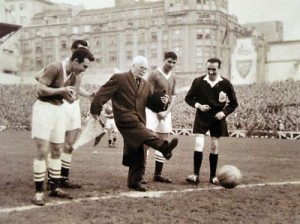
After a short spell as manager of Barrow, his career in football ended with the outbreak of World War Two. His impact on Athletic Bilbao was not forgotten though and he was invited back to San Mamés in 1959 to receive the club’s Distinguished Member’s medal. He kicked off a special testimonial game against Chelsea on this occasion, a feat repeated by his daughter Angela in 2010. His death in 1962 was commemorated at the San Mamés stadium by a special ceremony reserved solely for people who have significantly contributed to the Basque culture. His statue remains at San Mamés to this day.
The high water mark of his time at Bilbao was a 12-1 win over Barcelona in 1931, the record defeat ever suffered by the Catalans. This established his footballing philosophy as the superior one in Spain and was adopted nationwide with Barcelona and Real Madrid going on to owe much to the influence of El Mister as they dominated firstly Spanish and then European football.

Monday, 30 December 2013

Down by the Riverside

Middlesbrough architecture ancient & modern
The busy festive schedule always presents an opportunity to visit a new ground providing the weather is reasonable and the decision of the Football League to move their entire Christmas weekend programme from Saturday to Sunday offered ample choice. I plumped for a first ever trip to Teesside along with my friend, chauffeur and Reading season ticket holder Dave.
The stormy weather which has engulfed England recently fortunately abated for the day to present ideal driving conditions for the elementary route up the M1/A1. The dual carriageway which scars its way through the town of Middlesbrough deposited us right outside the Riverside stadium with time enough to take a short detour to the suburb of North Ormesby to find free parking and a pleasant walk towards the ground.
The Riverside
Middlesbrough is England's great nearly club. More successful in my lifetime than illustrious neighbours Newcastle United and Sunderland but without their status. For me the 'Boro's Cinderella sterotype is summed up by George Camsell's record breaking season of 1926/27 when he scored 59 goals, a record that stood for just twelve months before it was beaten by Dixie Dean by just one goal, the latter's mark of course standing almost certainly in perpetuity.
Gates open to all
The Riverside boasts that its the country's first new stadium built to the specification required by the Taylor report. The location is ideal being just a short walk from the town centre with a magnificent backdrop of the famous Transporter bridge. The main entrance is protected by the iron gates from Ayresome Park, infamously locked in 1986 when the club nearly went out of business, the gates themselves watched over by perhaps the 'Boro's two greatest players Wilf Mannion and George Hardwick.
Wilf Mannion
George Hardwick


A wander around the ground revealed evidence that industry still exists in Middlesbrough, along with the entrance to the Willie Maddren Education Centre before the familiar sight of the Horseman coaches came into view to signpost the entrance to the away section.

The Secondary Sector
One reason why I could not attend Football League matches every week is the predominance of all seater stadia, particularly those newly built in out of town locations. The impossibility of rolling out of a cosy pub and passing through the turnstiles onto a terrace, packed or otherwise is the reason why. Yes the sightlines from the seats might be great, the beer and food in the ground reasonably priced and of fair quality, but the cavernous concrete areas under the stand, the rows of empty seats on top and the need to manufacture an atmosphere means attending football at this level is a thoroughly uninspiring experience.
The game at the Riverside ticked all these boxes. The lager was flowing at (Southern) pub prices which you could drink whilst watching the live game on TV. The local speciality of a Parmo (chicken schnitzel topped with cheese) was possibly the best thing I've ever eaten in a football ground if that's not damning it with faint praise. The 195 (great individual commitment but collectively poor) travelling Reading fans were confined to a small block in the North East corner of the ground, resembling a dark button on a festive red winter coat, surrounded by empty seats in a ground that was less than half full. The North stand ultras to our left tried their best to create an atmosphere but from where we were sat it felt like we were looking in to the match rather than part of it as I'm sure would have been the case at Ayresome Park with a 16,000 crowd.
There was little for Reading fans to get excited about throughout the ninety minutes. Both clubs have new managers committed to playing football but it was Aitor Karanka whose values paid the greatest dividend with a comfortable 3-0 win taking advantage of some powder puff Reading defending to take a two goal lead into half time.
This state of affairs was exemplified by the goal of the game which gave 'Boro the lead in the twelfth minute. A long ball into the box by Emmanuel Ledesma was headed down by Lukas Jutkiewicz into the path of Albert Adomah who drilled his shot into the back of the net, a training ground move aided by the lack of challenge from the opposition. Jobi McAnuff almost conjured up an equaliser when he dribbled through the 'Boro defence only for his shot to be saved by the experienced goalkeeper Shay Given. This proved to be the closest Reading came to scoring, the poverty of the Royals' attacking play punished with nine minutes to go before half time when Grant Leadbitter was given the time and space to pick his spot and fire home the hosts second goal from fully twenty five yards.
After the break, Reading at least showed the determination to get back into the game but their comeback was almost over before it began when a reckless challenge from Casper Gorkss led to his second caution to reduce the Royals to ten men. The three points were sealed in the dying minutes when Leadbitter scored from the penalty spot after Ledesma had been brought down by a clumsy challenge from Alex Pearce.
This was the third win in a week for Middlesbrough who look set to soon pass a moribund Reading team in mid table as the Basque Karanka mounts a possible play off bid.